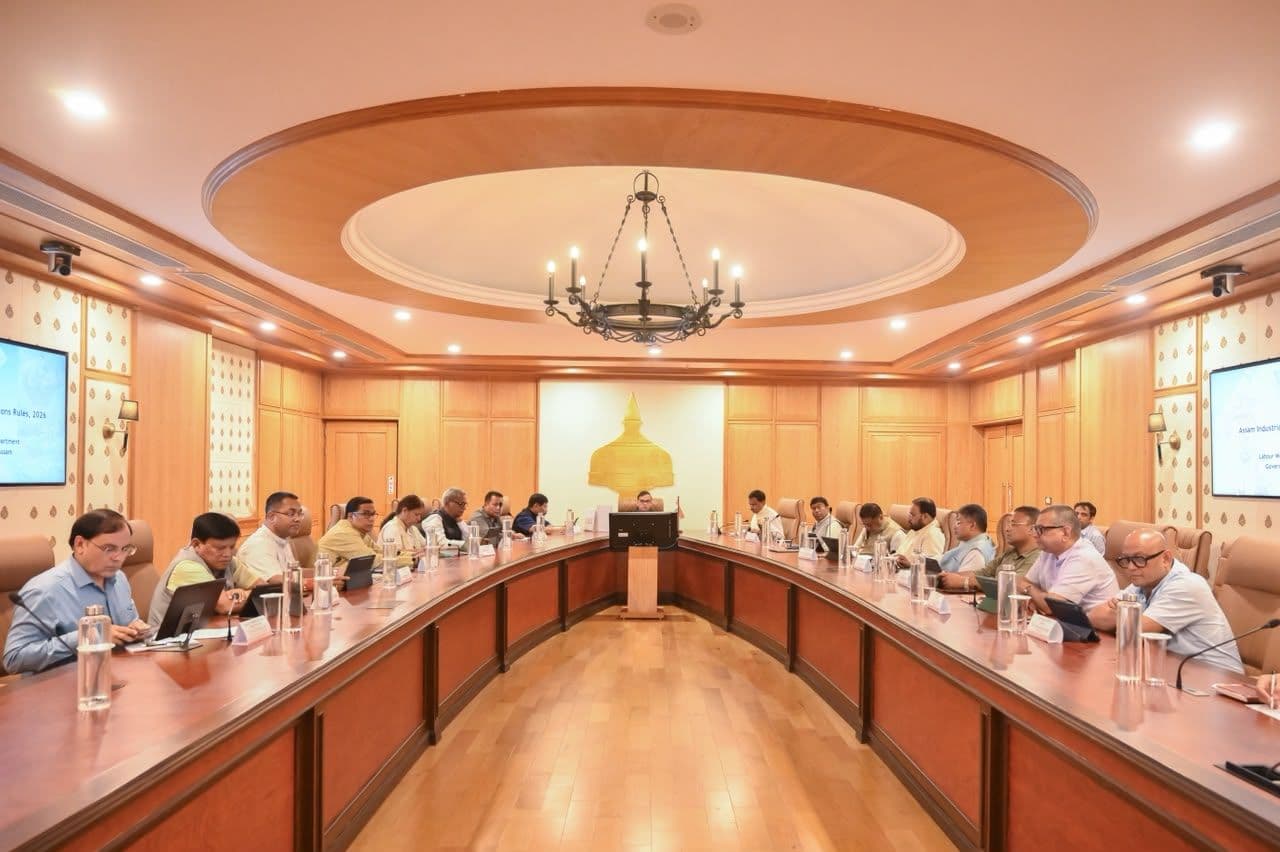
Guwahati, August 19: In what is being described as one of the more consequential Cabinet meetings of recent months, the Assam government on Tuesday approved a wide-ranging package of decisions covering youth affairs, child protection, higher education, labour laws, hydrocarbon exploration and administrative decentralisation. Chief Minister Himanta Biswa Sarma briefed the media after the meeting held at Lok Sewa Bhawan in Dispur, calling the decisions part of a continuing effort to bring government closer to citizens and to prioritise the state’s young population.
One of the most significant announcements was the creation of an entirely new Youth Empowerment and Welfare Department. Until now, youth-related programmes were scattered across different departments, often overlapping with sports. The new department will consolidate activities related to the Youth Commission, National Cadet Corps (NCC), Scouts and Guides, employment exchanges, and various student welfare schemes. Its mandate includes employment facilitation, career guidance, entrepreneurship support, leadership training and better coordination of youth initiatives.
“I believe Assam would be the only state in the country to have a separate department for youth, as most other states have it combined with sports,” the Chief Minister said. He added that the department is expected to become operational from September 17, with a secretariat, directorate and zonal offices at the district level. The existing Sports and Youth Welfare Department will now be redesignated simply as the Sports Department, allowing it to focus exclusively on sports development.
In another major administrative reform, the Cabinet approved the operationalisation of eight new co-districts. These are Kamalpur, Barhampur, Ranganadi, Sissibargaon, Chabua-Lahowal, Khumtai, Katigorah and Barkhola. With 39 co-districts already functioning, the total will rise to 47. The headquarters of the new units will be fixed at central locations identified by the respective District Commissioners in consultation with the Guardian Ministers. The co-district model, introduced earlier to reduce the distance between citizens and government offices, is being expanded further under the government’s “Ease of Governance” push.
Education infrastructure received a substantial boost. The Cabinet allotted 574 bighas of land at Marabhitha village under Baduar Mouza of Palashbari Revenue Circle for the permanent campus of the Indian Institute of Management (IIM) Guwahati. Separately, 200 bighas were allotted at Barduar Mouza under the same revenue circle for the establishment of Azim Premji University. Officials said the land transfers would help both institutions move towards full-fledged campuses and strengthen Assam’s higher education ecosystem.
Student mental health and safety figured prominently in the decisions. The Cabinet approved the Assam Private Coaching Institutes (Control and Student Mental Health Safeguard) Rules, 2026. Under the new framework, any private coaching institute with 50 or more students must register with the District Commissioner. Registration will have to be renewed annually, and institutes must submit infrastructure safety certificates complying with the National Building Code.
They will also be required to engage qualified counsellors, maintain a sensitive environment for students from SC, ST, OBC and EWS backgrounds, those with disabilities, and others facing trauma or mental health challenges. The rules specifically address suicide-prevention measures, including greater clearance for ceiling fans and the installation of grills on windows. “We want mental health to become an integral part of the coaching system,” Sarma said, noting the pressure competitive examinations place on young people.
On the child protection front, the Cabinet cleared the Assam State Child Protection Policy, 2026, along with the draft Assam Juvenile Justice (Care and Protection of Children) Rules, 2026. The policy aims to create a uniform protection framework across public and private institutions dealing with children and is aligned with directions from the Supreme Court and the Gauhati High Court. Childcare institutions will now be required to appoint welfare officers, install CCTV cameras and follow a prescribed code of conduct.
Labour reforms also featured in the meeting. The Cabinet notified the Assam Industrial Relations Rules, 2026, which replace three older colonial and post-Independence regulations, and the Assam Social Security Rules, 2026, framed under the Central Code on Social Security, 2020. These moves are expected to streamline industrial relations and social security provisions in the state.
In a decision aimed at strengthening administration in southern Assam, the Mini Secretariat in Silchar has been renamed the Assam Secretariat, Barak Valley. Thirty-two of the state’s 59 departments will function from the upgraded secretariat, giving the Barak Valley a more substantial administrative presence.
Other decisions included the full digitisation of registration for dairy cooperative societies (targeted to be completed in one day online), the Assam Hydrocarbon Exploration, Production and Upstream Ecosystem Development Policy, 2026 (valid for five years), and the transfer of the Directorate of Economics and Statistics to the Finance Department for better fiscal and planning coordination.
Taken together, the package reflects the government’s stated priorities of youth empowerment, child safety, decentralised governance and educational expansion. Officials indicated that notifications and detailed operational guidelines would follow in the coming weeks.